The Music that Rocked the World
After the pathbreaking rock of the 60s and 70s, “rock stars” have become cultural symbols of transgressive freedom, artistic innovation, and edgy glamour that captures the hearts of fans—sometimes to the point of mania. And their 19th-century musical ancestors were not so very different.
In our free online course, “The History of Classical Music: Chopin Through Gershwin,” Hyperion Knight shows how the 19th-century Romantic pianists revolutionized the musical world with their use of the keyboard—and with the shocking responses they could inspire in their fans.
Hardly a century old by the onset of the 19th century, the piano was “ground zero” for the innovations in music inspired by the impulses of Romanticism. This was in part due to the mechanical evolution the instrument had undergone; ever since Beethoven, pianos had grown increasingly more powerful until composers like Frédéric Chopin and Franz Liszt came along and rollicked them to their full potential.
Adapting an emerging vocal technique from Italian opera, Chopin used the piano’s damper pedal on the resonant strings to mimic the sound of the human voice. In this way, he created an instrumental imitation of the vocal bel canto of the Italian stage, in which the melody was the central part of the structure. This melody was then enhanced by the performer’s own creative liberties and ornamentation known as rubato—”time robbed from one note and given to another so that some notes would dance around the beat rather than landing in strict time.” The most well-known examples of these techniques are found in Chopin’s haunting and beautiful Nocturnes (“Night Music”).
Chopin’s revolutionary propensities were not confined to his artistic compositions. In his personal life, Chopin carried on a romantic affair with the female author George Sand (born Aurore Dupin). Sand not only used a masculine pen name to achieve success with her writing, but she also wore men’s clothing and smoked cigars. In his private letters, Chopin addressed her as “George.” Chopin composed many of his most memorable works (such as the Fantaisie in F minor, Op. 49, Piano Sonata No. 3, Op. 58, and the Ballade No. 3, Op. 47) at Sand’s country estate in Nohant. The couple had been introduced through Franz Liszt, a musical sensation in his own right.
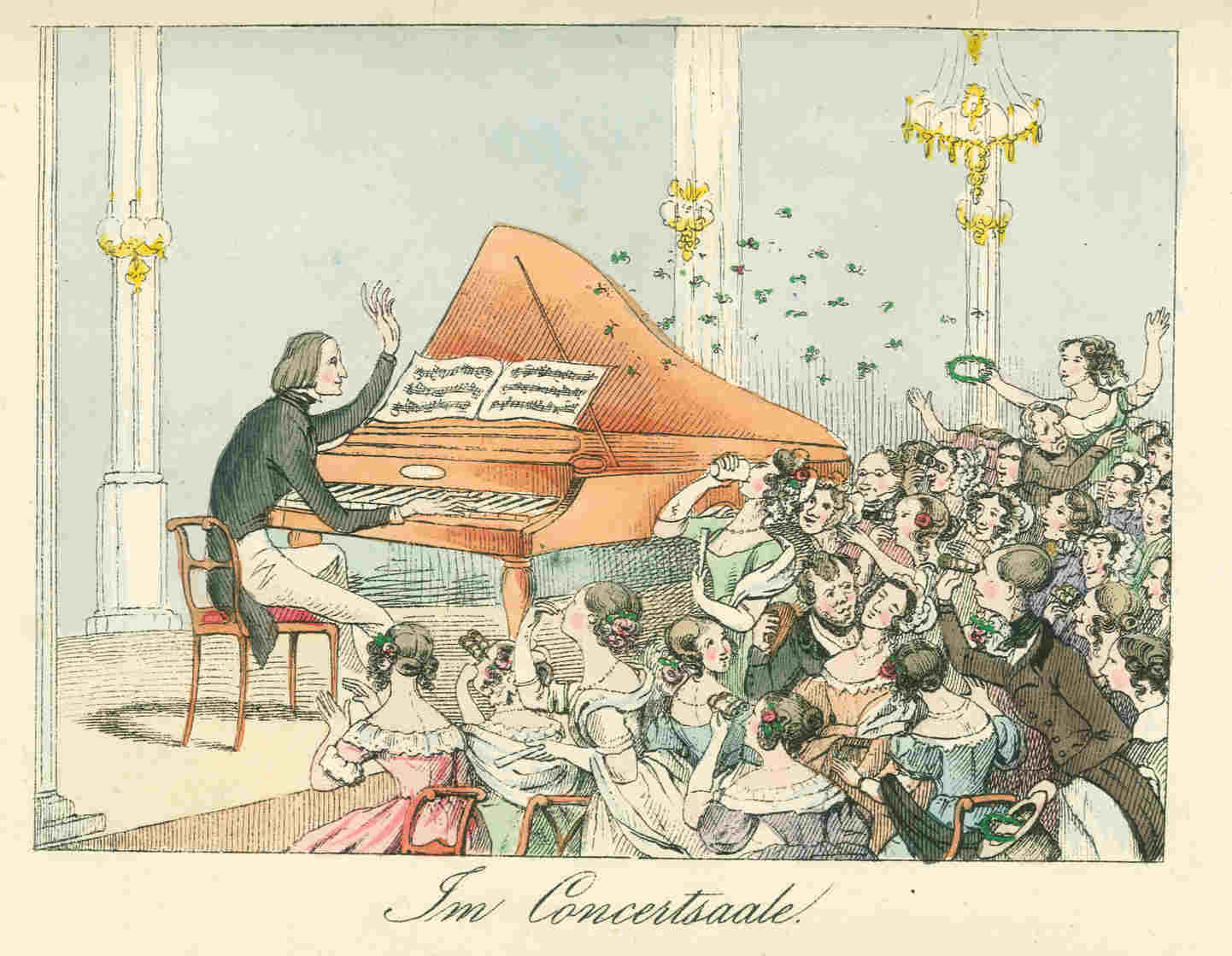
Knight calls Liszt “the first true superstar of classical music,” enjoying an intense following that was similar to that of 20th-century rock icons. The popularity of Liszt was so extreme that a Hungarian music critic coined a term for the hysteria his concerts would incite in mid-19th-century Germany: “Lisztomania.”
That’s right—before Beatlemania there was Lisztomania; before “Night Fever” there was “Liszt Fever.” The phenomenon was characterized by the frenzied ecstasies his music produced in his audiences and by the extreme devotion of his fans. Well-mannered aristocratic women suddenly began to flock to him, fighting over his gloves and handkerchiefs, stealing locks of his hair, grasping for broken piano strings, and even pouring the dregs of his coffee into glass phials. In his book, Franz Liszt: The Virtuoso Years, 1811-1847, Alan Walker points out:
Liszt once threw away an old cigar stump in the street under the watchful eyes of an infatuated lady-in-waiting, who reverently picked the offensive weed out of the gutter, had it encased in a locket and surrounded with the monogram “F.L.” in diamonds, and went about her courtly duties unaware of the sickly odour it gave forth.
Another author, Dana Gooley, notes in her book, The Virtuoso Liszt, that when the hysteria in Northern Germany aroused the concerns of their southern neighbors, an 1843 Munich newspaper felt compelled to reassure locals they would suffer no harm thanks to their stronger constitutions:
Liszt fever, a contagion that breaks out in every city our artist visits, and which neither age nor wisdom can protect, seems to appear here only sporadically, and asphyxiating cases such as appeared so often in northern capitals need not be feared by our residents, with their strong constitutions.
Liszt’s flamboyant life was reflected in the innovations he introduced into the musical world with his art. His “Un Sospiro” (“A Sigh”) creates the impression of sighs with his “three-handed” technique, which creates the illusion of more than two hands playing. When performing, Liszt broke convention and would play alone without other musicians, pioneering what we now call “recitals,” a term which likens the piano performance to poetry reading. Liszt would play entirely from memory and without sheet music.
Although their music might sound tame to modern ears, Chopin and Liszt were pioneers of Romanticism, which paved the way for modernism and laid the groundwork for music as we know it. Their remarkable lives are a reminder that there is no genius without a touch of insanity, and that “neither age nor wisdom” can resist it.