Faith & Reason in Hans Christian Anderson
Many of us are familiar with Disney’s modern films. After all, they are some of the highest-budget films in Hollywood’s production schedule, and their cutting-edge voice acting, scores, and world-famous songs are nothing to sneeze at. Disney’s Frozen, in particular, was a smashing success, reaching No. 1 on the worldwide box office charts at its release. However, most people are unfamiliar with the story Frozen is based on—The Snow Queen, by Hans Christian Andersen.
An intricate tale of a young girl’s journey to rescue her friend from the icy prison to which he fell prey, Daniel Coupland discusses The Snow Queen in our free online course, “Classic Children’s Literature.” As Coupland explains, Andersen’s story focuses far more on the intersection of childlike faith with cold, precise rationality than on the sisterly affection that Disney presents as the central theme.
So, what is the difference between faith and reason? And what can faith do that reason cannot?
Coupland asks these questions of his audience, just as Andersen does of his.
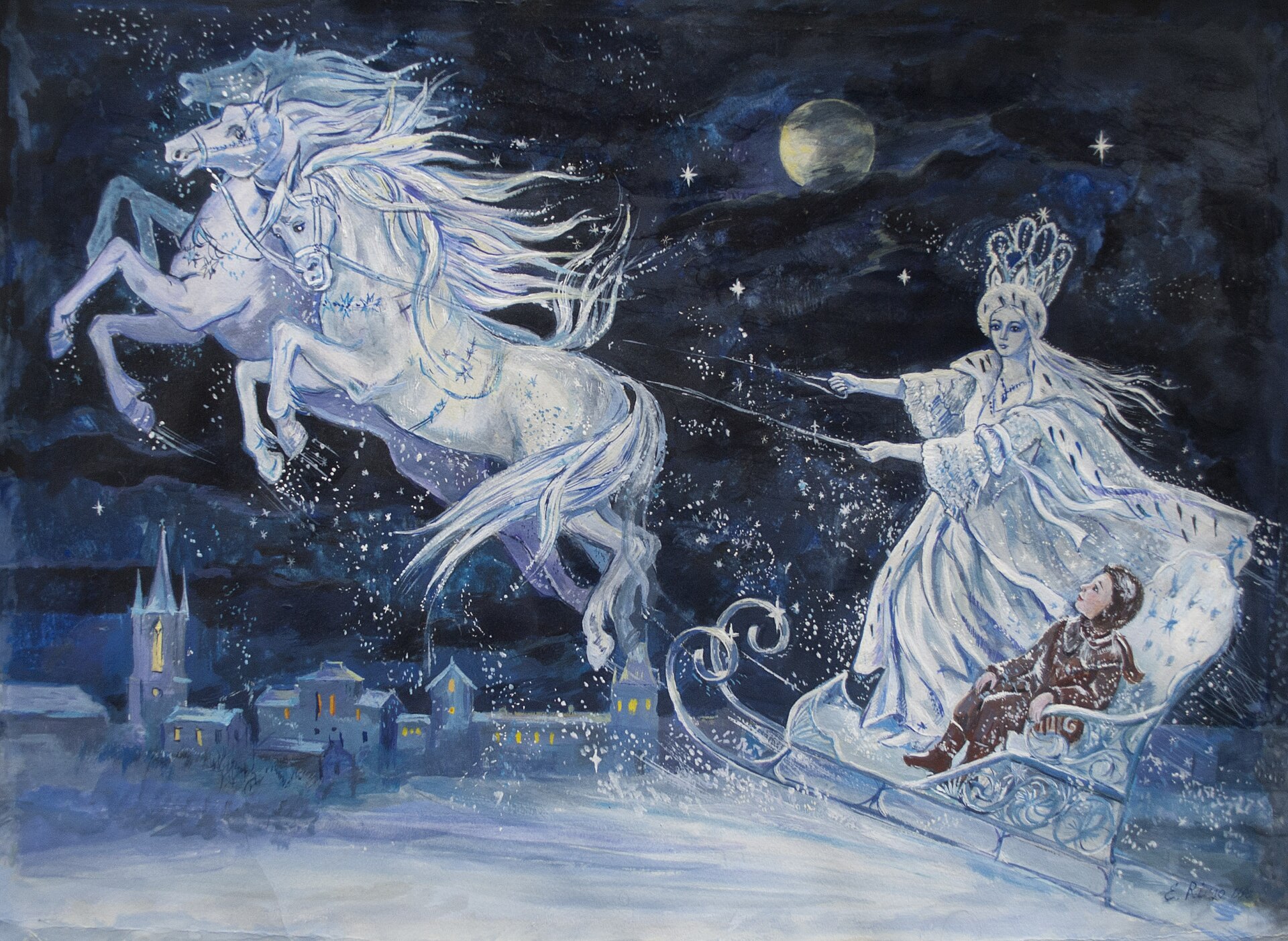
First, the elements of the story are these: the devil’s mirror that twists reality, making the beautiful into nothing and the ugly even more monstrous; Kay and Gerda, two children who enjoy each other’s company and spend their time playing together; and the Snow Queen, who is the most mysterious character by far. The plot of the tale thickens when the shattered pieces of the mirror fall to the earth and enter Kay’s eye and heart. His heart immediately becomes like a lump of ice, and his vision of the world is twisted. Coupland describes the stark shift in the relationship between Kay and Gerda:
As soon as the piece of glass enters his eye and heart, immediately he [sees] Gerda [with] . . . a lack of compassion. He’s going after easy targets. And rather than acting in a charitable way, he’s identifying those people who are unpleasant and mocking them.
Coupland points out this shift from a kind, compassionate, loving child to one who takes delight only in mocking others and engaging in scientific games.
One such game Kay takes up is examining snowflakes with a magnifying glass. Kay directs the view to Gerda, about which Coupland notes:
Notice that as Gerda marveled at the snowflake and said it reminded her of the flower—of how beautiful the flower was—he [Kay] immediately wants to make a comparison: “It’s much more interesting than a real flower. It’s perfect.”
The culmination of Kay’s pursuit of perfection occurs, however, when his obsession allows the Snow Queen to lure Kay to her crystalline palace. As the full weight of his course hits home, Kay is seized by terror and seeks one last connection to the simple life he abandoned in pursuit of rationality. Coupland points out the contrast and his ultimate shortcoming: “Notice the dichotomy here: ‘He tried to say the Lord’s Prayer.’ That’s a connection to his previous life with Gerda and his grandmother, who used to say the Lord’s Prayer frequently. This is a symbol of faith in that home environment. ‘He tried to say the Lord’s Prayer, but all he could remember was the multiplication table.’” At this point, all remnants of the faith that he previously held seem to have vanished, and all seems lost for Kay.
Meanwhile, Gerda, who has been rejected, insulted, and rebuffed by this new Kay, and who was not struck by the pieces of the mirror, still loves him very much, in fact, “more than anything in the whole world,” according to Andersen. It is by the power of this love and the faith that she can accomplish her mission and endure many strange and wonderful encounters on a journey to find Kay and bring him back home.
The seventh part of the story includes Gerda’s arrival at the Queen’s palace. She finds Kay sitting atop a lake of ice, split into a thousand perfect pieces, which the snow queen called “The Mirror of Reason.” For the second time in the story, Kay interacts with a mirror. This time, he has been tasked to spell the word ETERNITY using the pieces of icy glass. But try as he might, his heart frozen, his hands blue, he is unable to do it. Coupland asks,
Why the word eternity?
Indeed, what is so special about that word that the snow queen offers Kay his freedom and a new pair of skates for it? Coupland answers his own question by digging deeper into the meanings of the strange words Andersen has selected.
That just so happens to be one of the big mysteries of humanity. Why do we die? Can we live forever? If so, how do we live forever? The snow queen has given him these tools, these tools on The Mirror of Reason, but try as he might, he’s never able to arrange them into the word eternity.
Finally, the moment of transformation, of Eucatastrophe, which Tolkien wrote was necessary for any fairy tale, occurs. Gerda, seeing Kay’s frozen face, began to weep hot tears over him. The tears wash away the splinters of glass that have been embedded in his heart. Kay, recognizing his friend, began to cry as well, washing out the splinter in his eye. In this moment of joy, Andersen explains that everyone, even the blisteringly cold wind and ice, experienced such great joy that they danced. But when the icy tools Kay had been working with ceased moving, they lay in the exact pattern which Kay had attempted to make—the word Eternity.
So, what is the purpose? What is Andersen trying to communicate through the transformations Kay undergoes, the determined faith of Gerda, the Mirror of Reason, and the concept of Eternity, which Reason doesn’t seem quite sufficient to grasp? Coupland concludes by summarizing the work’s significance.
The tools of reason weren’t the problem. They were actually useful, and they did form the word that he was supposed to form. Reason is not evil, and it can be useful, as long as we don’t expect too much of it. Reason will only work if it operates in a broader understanding of reality. One that includes faith.
Andersen uses what seems a simple, even silly, children’s tale, complete with the descriptions, characters, and plot one would typically expect from such a story, to communicate a far more profound truth about the relationship between Faith and Reason. Neither Faith nor Reason is unequivocally good or evil. Both are tools given to us as humans to use to strive for truth, and we are most effective in that search when we use both to the fullest.