Who Was Cicero?
John Adams wrote that “all the ages of the world have not produced a greater statesman and philosopher united than Cicero.” Speaking over 1800 years after the death of antiquity’s most famous orator, John Adams attested to the enduring power of Cicero’s extraordinary life.
Cicero’s synthesis of philosophy and statesmanship was extraordinary because it seemed to defy a proverbial problem first articulated by Socrates. While Socrates famously asserted that the ideal state is governed by a wise philosopher king, he also implied that this ideal was elusive. Philosophy, for one thing, was the work of a lifetime and left little time for anything else—including and especially the demanding labor of political service.
Although Cicero acknowledged his tremendous intellectual debt to Socrates, in one of his own master works of political philosophy he accused Socrates of “severing the heart and the tongue” in suggesting that the philosophic life precludes public service; Socrates’ emphasis on the tension between philosophy and politics had severed two things that naturally belong together. Cicero questioned whether “wisdom” could be considered complete until it had been tested in a life of service.
Who was Cicero, what kind of life did he lead as Rome’s most memorable statesman, and how did it prepare him to compose the great philosophical treatises penned near the end of his life? In the fourth lecture of our free online course, “The Rise and Fall of the Roman Republic,” Carl Young shares the story of Cicero’s life and career during Rome’s most tumultuous period.
The young Cicero’s swift rise to political prominence was striking for several reasons. Cicero was a novus homo or “new man,” a member of the equestrian class rather than an elite patrician and the first in his family to be elected to high office. Cicero was also exceptional in that he was elected to every office he held in the first year that he was eligible, despite his minimal military experience.
As a statesman Cicero promoted a policy of unity between the elite and lower classes but opposed the radical populist agenda of redistributing land and cancelling debts.
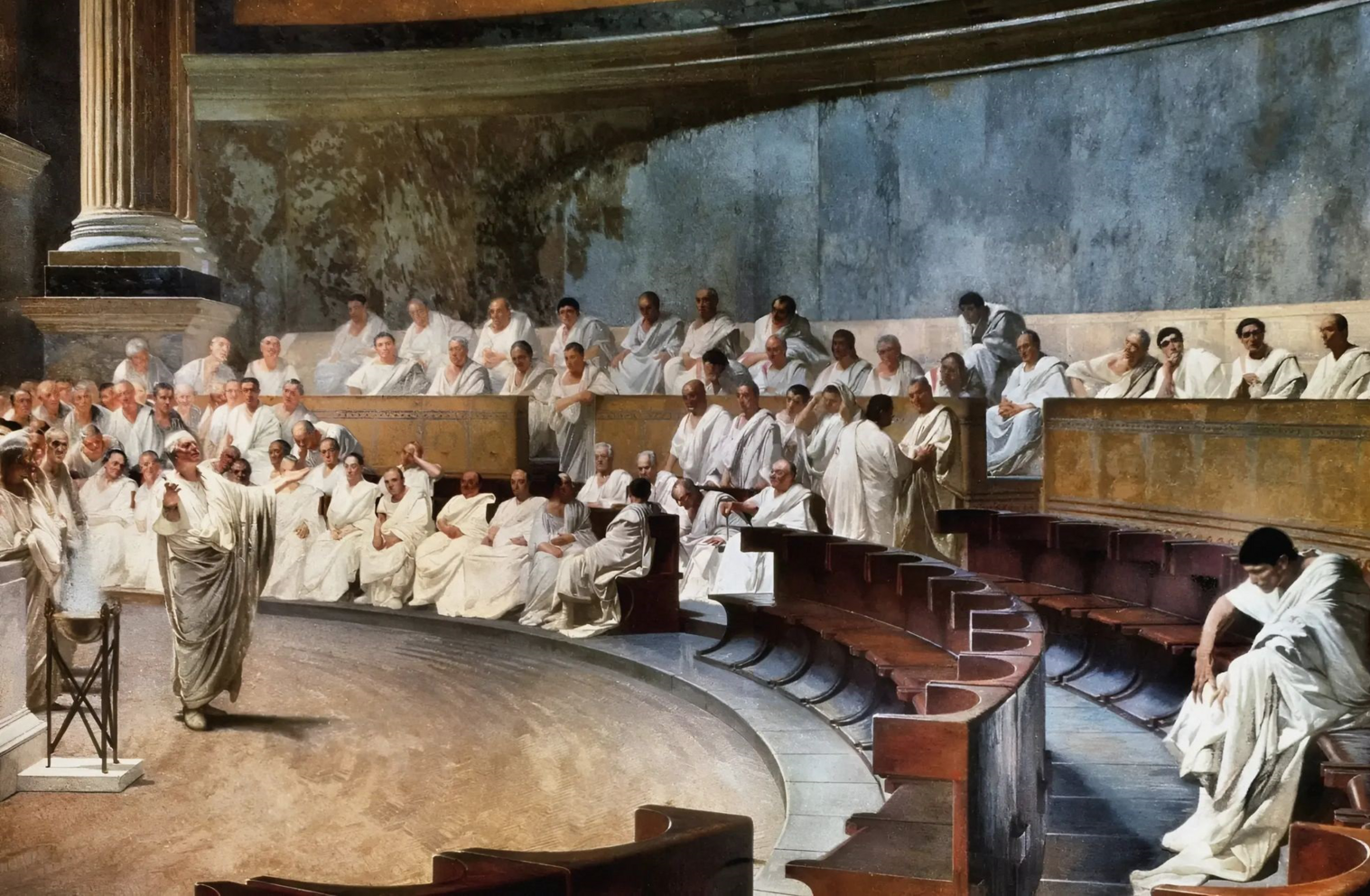
Tumult in Rome intensified in 64 BC when Cicero opposed Catiline in the election for the consulship, Rome’s highest office. Catiline was from an ancient, noble family, but his radical economic policies were not well received by the wealthy members of the voting citizenry. When Catiline lost the consulship to Cicero, he fled Rome, amassed an armed force, and organized a conspiracy against the republic.
Through a network of spies, Cicero became aware of the conspiracy—and of the betrayal of five complicit senators—and of their plans to burn down the city of Rome.
Cicero persuaded the Senate to attack Catiline and prevent the siege, earning the title “Pater Patriae,” or “father of the fatherland” for his service to the republic. Following this victory, the five traitors were summarily executed and Cicero carried out the edict. While his defeat of the Catilinarian Conspiracy was a high point in his career, he would suffer for his role in the execution of the senators without due process of law.
Despite his popularity and his successes, Cicero had enemies. In 62 BC Cicero had testified against Publius Clodius Pulcher, who was now tribune of the plebs. Four years later, Clodius took his revenge on Cicero by prosecuting him for the unconstitutional killing of the five senators. Cicero anticipated the verdict and fled Rome for Greece in a self-imposed exile. During that time Cicero suffered a mental breakdown.
But Cicero’s career did not end; when he returned to Rome, he was able to take advantage of the tension between Caesar and Pompey and exert some political influence. But when these sometime members of the First Triumvirate repaired their alliance, they again forced Cicero into submission. It was at this point that Cicero realized that he must serve the republic another way. Retiring once again in the mid 50s BC, Cicero composed his great works of political philosophy, De Republica and De Legibus.
Cicero’s works of political philosophy are famously practical and, many find, easy to read and relate to. This fact is not accidental; his humane and friendly style of writing likely proceed from his opinion that philosophy is not meant to be something remote and esoteric, but to cultivate and dignify ordinary, human life. For Cicero, “wisdom” is not merely the perfection of the intellect, the possession of abstract notions in the mind, but a life wisely lived in pursuit of virtue. In the preface to De Republica he wrote:
Virtue is not some kind of knowledge to be possessed without using it. Even if the intellectual possession of knowledge can be maintained without use, virtue consists entirely in its employment. Moreover, its most important employment is the governance of states and the accomplishments and deeds rather than words of the things that philosophers talk about in their corners.
The priority of virtue in Cicero’s thought leads him to emphasize the importance of civic life and the role of philosophy in service of politics, rather than viewing philosophy as a purely speculative endeavor, terminating in the pleasure or self-satisfaction of the philosopher. For Cicero, “philosophers” who fail to devote attention to their civic roles are playing juvenile games to the detriment of their fellow citizens.
But Cicero was no utopian dreamer, and his own painful experiences left a realistic impression of the limits of politics. Like Plato’s Republic, on which it is modeled, De Republica presents an ideal regime, but also warns about the practical drawbacks of utopianism and the dangers of idealism. But this hard-earned realism makes Cicero’s positive vision of political life all the more remarkable. Well aware of the dangers and personal risks, Cicero continued to affirm that public service was a worthwhile, noble, and eminently human endeavor.
After the composition of these works, Cicero continued to serve. He took on the proconsular governorship of Cilicia and then returned to a Rome that was torn apart by civil war. Cicero tried to negotiate a compromise between Caesar and Pompey but was unsuccessful and unable to rescue the republic as he had known it. In Cicero’s view, Caesar’s victory marked the end of the republican regime.
With Caesar in control of Rome, there was no place for Cicero in public life. But, once again, Cicero’s retirement was fruitful. During this period, he wrote his great treatises on the art of rhetoric, De Oratore and Brutus, and his works on moral philosophy and theology: De Finibus, Tusculanae Disputationes, and De Natura Deorum. He also wrote moving treatises on old age and friendship along with his masterpiece, De Officiis.
Cicero’s most mature treatise on human duty boldly argues that there is no ultimate conflict between personal interest and moral integrity, although human beings in their frailty often experience these things to be in tension. Cicero affirms that acting on the requirements of conscience and justice always redounds to a person’s own good.
After suffering the defeats and persecutions that Cicero did, this final position suggests that he harbored no bitterness or cynicism regarding the moral universe inhabited by human beings. After acknowledging his literary contributions to the Western tradition, Cicero’s resolute confidence in the goodness of human life, especially a civic life fraught with trials, makes him worthy of our remembrance.