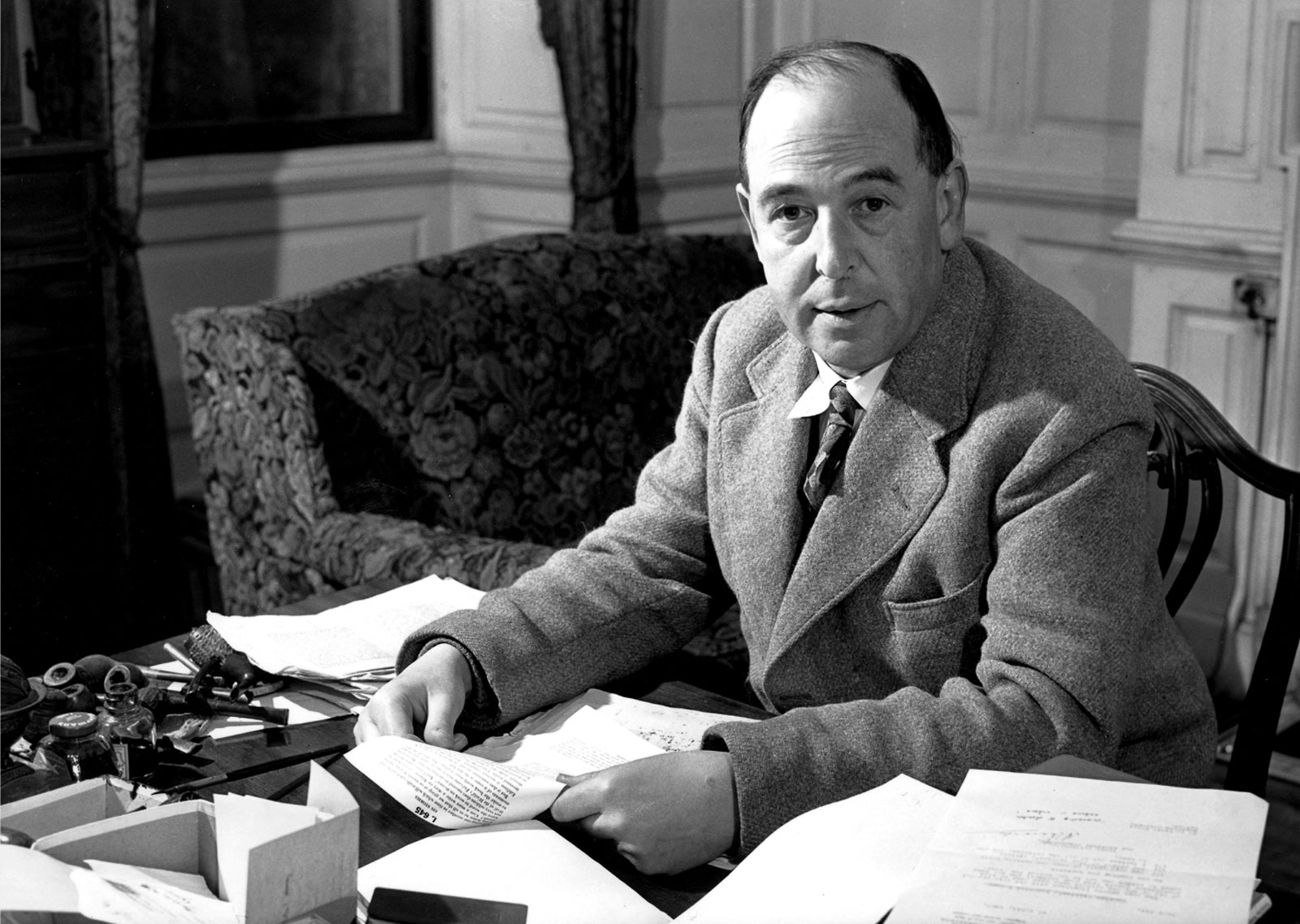
C. S. Lewis Compares 1984 and Animal Farm
Critical readers have long noted the erotic motif running through George Orwell’s 1984. In Lesson 2 of our free online course, “Totalitarian Novels,” the seminar discussion quickly turns to this theme.
As the conversation begins, Addison Longenecker doubts that the story’s hero and heroine, Winston and Julia, truly love each other. In reply to this, Larry Arnn observes that C. S. Lewis also had his own criticisms about this relationship—though Arnn himself believes there is more literary substance in the portrayal than Lewis allowed.
Lewis articulated this criticism more fully in a comparative review of 1984 and Animal Farm, Orwell’s much shorter parable. What puzzled—and annoyed—Lewis was how few people seemed even to be aware of Animal Farm, which he considered the far superior work of the two.
In his view, 1984 was not a bad book, but it contained more than its share of literary “deadwood,” and this fault extended into the characterization of both Winston and Julia themselves. Alluding to classic literary metrics dating back to Aristotle, Lewis insists:
Tragedy demands a certain minimum stature in the victim; and the hero and heroine of 1984 do not reach that minimum. They become interesting at all only in so far as they suffer.
Simply put, Winston and Julia are not sufficiently interesting. Because their suffering is the only thing that raises them above “nullity,” he considers them a literary “failure.” Indeed, “the hero and heroine in this story are surely such dull, mean little creatures that one might be introduced to them once a week for six months without even remembering them.”
It is in this broader context that Lewis picks at the novel’s eroticism, which he sees as an underdeveloped attempt to color in the regime’s authoritarianism. To quote Orwell’s own words in the story,
What was more important was that sexual privation induced hysteria, which was desirable because it could be transformed into war-fever and leader-worship.
Julia herself then articulates further:
When you make love you’re using up energy; and afterwards you feel happy and don’t give a damn for anything. They can’t bear you to feel like that. They want you to be bursting with energy all the time. All this marching up and down and cheering and waving flags is simply sex gone sour. If you’re happy inside yourself, why should you get excited about Big Brother and the Three-Year Plans and the Two Minutes Hate and all the rest of their bloody rot?
In this and other passages, Lewis was arguably correct to detect a dash of pop-Freudian, anti-Victorian infatuation with sexual repression. What Orwell has done, according to Lewis, is drag in an unscrutinized presupposition that what is often (and misleadingly) called sexual “Puritanism” would of course go hand-in-hand with totalitarian ideology.
At risk of playing the literary critic ourselves, it must be said that Lewis has a point here. One indicator is the degree to which Julia’s theory about sexual repression leaps out as such a peculiar vestige of the mid-twentieth century: one struggles to imagine that a repressive regime would be described in such terms either today or in the nineteenth century, which suggests that Orwell had indeed unwittingly indulged in a quasi-intellectual fashion of his time.
To put it another way, even accepting Julia’s premise, we can just as easily envision a totalitarian society more in line with Brave New World, one that expressly encourages sexual libertinism for the express purpose of enervating the populace. As an author, Orwell was of course free to depict what came to his imagination, but Lewis’s larger critique is that the sexual-repression angle was essentially undertheorized and unearned in the rest of the story.
And that is where the comparison with Animal Farm may be most clarifying: as a much tighter parable, it maintains a timeless quality in its moral and thematic logic. It also achieves a much more fulsome (albeit counterintuitive) verisimilitude in its animal characters, whereas Winston and Julia remain relatively colorless and one-dimensional.
Lewis explains,
The greed and cunning of the pigs is tragic (not merely odious) because we are made to care about all the honest, well-meaning, or even heroic beasts whom they exploit. The death of Boxer the horse moves us more than all the more elaborate cruelties of [1984]. And not only moves, but convinces. Here, despite the animal disguise, we feel we are in a real world. This – this congeries of guzzling pigs, snapping dogs, and heroic horses—this is what humanity is like; very good, very bad, very pitiable, very honourable. If men were only like the people in 1984 it would hardly be worthwhile writing stories about them.
Why then the greater popularity of 1984, which Lewis calls “so discouraging”? He proposed a few explanations. For one, 1984 was much longer, and so it could hold interest for longer. Another possibility is that 1984 belonged to a recognizable and popular genre of dystopian stories, whereas a superficial reader might mistake Animal Farm for a children’s story. Finally, it could be that the same conceptually flawed eroticism present in the longer work was the key difference in its more enthusiastic reception.
In closing, it should be noted that Lewis’s review appeared almost a decade after Orwell himself had reviewed Lewis’s own dystopian story, That Hideous Strength. If Lewis found Orwell’s tale too drab to resemble real life, then Orwell’s main criticism had been that Lewis’s was far too colorful: Lewis would have preferred excising the unnecessary eroticism and Orwell would have preferred Lewis leave out the unnecessary miracles.