Marxism and Religion
“The ideas of socialism have a powerful pull on the hearts of men.” These are the first words uttered by Hillsdale College Professor of Economics, Ivan Pongracic, in our newest course, “Marxism, Socialism, and Communism.” Yet, this political philosophy that claims to be for the people has only ever caused immense harm to the people.
On the surface, socialism presents noble and good ideas. One of the goals of socialism is to create a level playing field for all people. Some forms of socialism go so far as to suggest that the goal is utopia—a perfect society. No poverty, no war, and no suffering of any kind.
But considering the socialist societies throughout history, it takes no genius to realize that socialism achieves everything opposite to that for which it strives. Mass poverty, incessant war, and immense suffering are its results. As Hillsdale College Professor of Politics, John Grant, poignantly puts it, “attempting to eliminate all evils actually means you have to commit terrible, terrible evils, and you never get to a better place either.”
So, why do Marx’s ideas of socialism continue to penetrate so many aspects of societies to this day?
The answer: the absence of God.
For all of history there has been a battle in the human soul. The soul is oriented toward its Creator and pulled away by Satan’s attempt to sever man from God. This is why ideas—both good and evil—have “a powerful pull on the hearts of men.” This is not to say that God is completely absent from the minds of everyone within these Marxist societies, but rather that the individuals who push socialism to the forefront of a nation are people who hold a pessimistic and Godless view of society. Their goals, therefore, are immoral and ungodly.
Karl Marx, the co-author of The Communist Manifesto, was descended from a Jewish family, but his father converted to Lutheranism to assimilate into German society. His mother converted a few years later. Marx was therefore raised by nominally Christian parents and thus, was no stranger to religion. In fact, Marx wrote about religion and acknowledged God simply as the product of human thought. In the words of Marx, “Religion is the sigh of the oppressed creature, the heart of a heartless world, and the soul of the soulless condition. It is the opium of the people.”
A professing Christian may have trouble wrapping his head around how someone would diminish faith in this way. Whether Christian or not, there is no denying that deep within the human soul something is wrong—we are fallen. Although all human beings are fallen, there is also a source of hope within them that is their lifeblood. It’s what causes them to keep fighting for life, goodness, and truth when the world looks bleak.
For a Christian, this hope is the hope of salvation through Christ. For Marx, “Communism begins where atheism begins.” In order for man to be truly free, man must be free from religion so that his blindness may become sight.
Marx’s ideas eventually gripped nations. The Communist Manifesto was published in 1848, and shortly thereafter, tyrants such as Vladimir Lenin, Joseph Stalin, and Mao Zedong revealed to the world the effects of a political philosophy devoid of God.
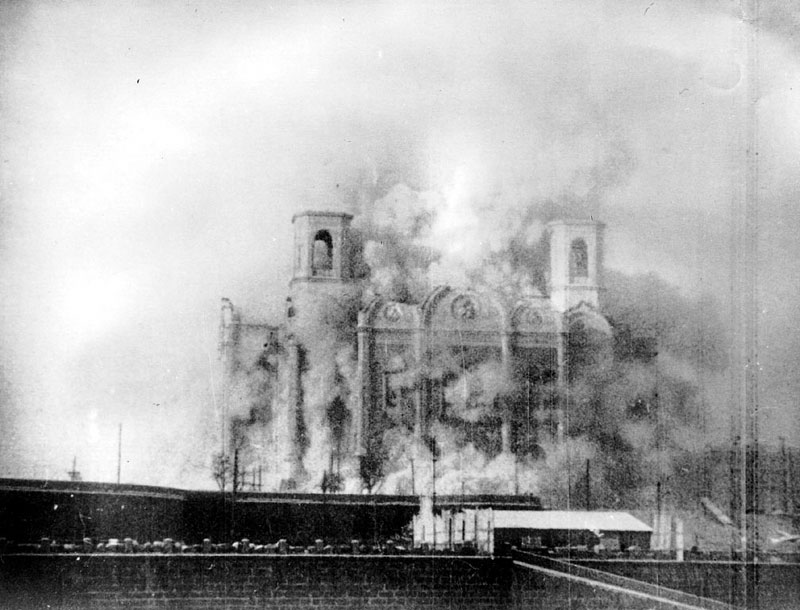
The histories of Soviet Russia and Communist China are prime examples of what happens when a utopian philosophy takes control. The only results of a system that is opposed to God will be misery and destruction. No matter how many times Marxism has been and will be presented as a noble and honorable system, it will fail. The battle has already been won. God is on His throne.